Here are some selected posts from our eValid forum:
Can eValid's "Manager" convert my tests
-- How eValid organizes tests into projects, groups, and tests within a group
for easy regression test tree creation.
eValid vs CUIT Question
-- Details on how eValid and VS2014's CUIT system overlap.
eValid can't log in to my application
-- Some hints on overcoming this common issue.
Using eValid to test a website in Hindi
-- Comments about using eValid's International Edition, which supports
all 2-byte chracter sets (DBCSs).
Thursday, August 28, 2014


Wednesday, August 13, 2014
Selected Recent Forum Postings
Here are some selected posts from our eValid forum:
Number of Tests Question -- More discussion about geting more and more and more tests in parallel.
Using eValid as building blocks for an application -- Suggestions about possible eValid product component deliverable(s) that you could put in your own product.
A question on eV.Manager -- Some key details about eV.Manager -- the eValid automated regression controller.
Running a test suite on alt browser -- Some pointers for using eValid to simulate (imitate) non-IE browsers for non-desktop devices.
Number of Tests Question -- More discussion about geting more and more and more tests in parallel.
Using eValid as building blocks for an application -- Suggestions about possible eValid product component deliverable(s) that you could put in your own product.
A question on eV.Manager -- Some key details about eV.Manager -- the eValid automated regression controller.
Running a test suite on alt browser -- Some pointers for using eValid to simulate (imitate) non-IE browsers for non-desktop devices.
Friday, August 1, 2014
Scaling Issues in Mobile Testing
The number of different mobile devices keeps growing.
According to a Ryan Lawler post, some
7,000 Different Types Of Mobile Devices Access Facebook Every Day
.
Daily.
And this was in 2012.
The total number of combinations that may need to be tested
is surely growing.
Two factors are involved: the number of different browser versions (currently > 500) and the number of different device development environment versions (currently > 100).
You have to multiply these two factors to get the total "perfect" test count.
Two factors are involved:
the number of different browser versions (currently > 500)
and the
number of different device development environment versions (currently > 100).
You have to multiply these two factors to get the total "perfect" test count.
Hence, scale is clearly important if you are working on testing mobile web applications.
With that many device-browser combinations it becomes
quite difficult to obtain actual instances of all of these devices.
While some service solutions we've seen
offer direct device tests of several hundred combinations,
using actual devices that are controlled remotely,
device-browser combinations in the 1,000's or 10,000's just aren't feasible economically.
eValid can overcome a major part of that difficulty with its ability to imitate other any browser. eValid can do this when launched from a command line option, or it can do this in individual subwindows launched inside a playback script using the SetUserAgent Command. The result is a quick -- and highly scalable -- method to test a web application
in a variety of browsers.
The behavior variations between browsers can be quite remarkable, as this Mobile Agent Demonstration Experiment shows. For these 20 different mobile device browsers it's important to note how the pages vary, and how big the variations are in the downloaded file size.
For good measure, here are
Selected Screenshots for 200+ Mobile Devices.
Using eValid's device imitation feature it's possible to run full-realism, dynamic tests on 1,000's of browser variations by just putting the playback process in a loop, each repetition trying a different setting. Web application validation — an otherwise very difficult task to to with 100% thoroughness — becomes much easier because you can use a single test appliance with great scaling leverage.


Two factors are involved: the number of different browser versions (currently > 500) and the number of different
Hence, scale is clearly important if you are working on
eValid can overcome a major part of that difficulty with its ability to imitate other any browser. eValid can do this when launched from a command line option, or it can do this in individual subwindows launched inside a playback script using the SetUserAgent Command. The result is a quick -- and highly scalable -- method to test a web
The behavior variations between browsers can be quite remarkable, as this Mobile Agent Demonstration Experiment shows. For these 20 different mobile device browsers it's important to note how the pages vary, and how big the variations are in the
Using eValid's device imitation feature it's possible to run full-realism, dynamic tests on 1,000's of browser variations by just putting the playback process in a loop, each repetition trying a different setting. Web application validation — an otherwise very difficult task to to with 100% thoroughness — becomes much easier because you can use a single test appliance with great scaling leverage.
Tuesday, July 29, 2014
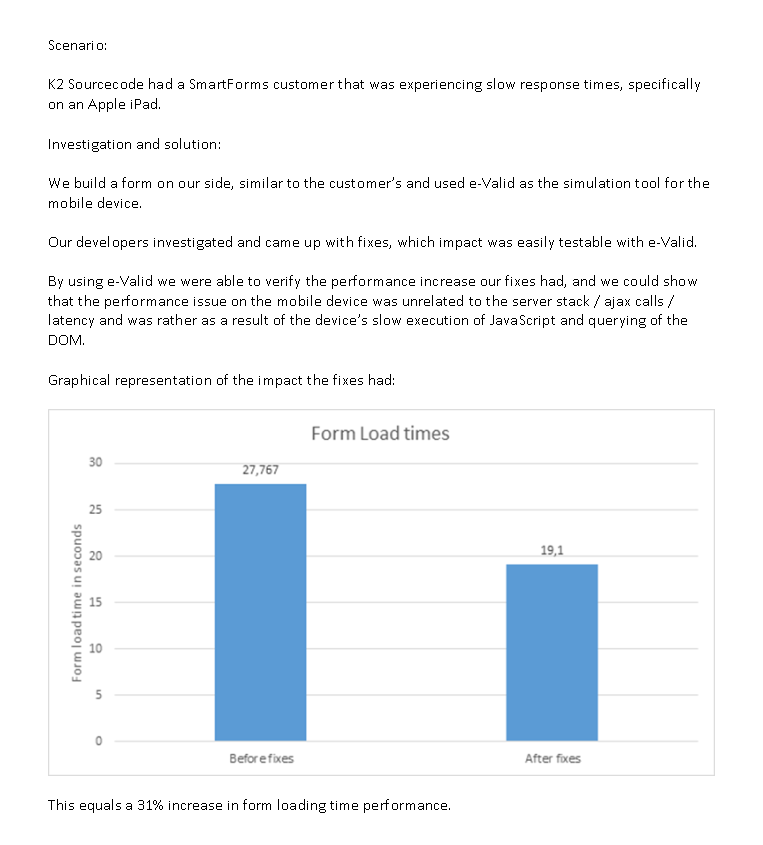
Customer Finds Mobile Performance Flaw
We heard from an eValid user about a novel use of the internal timing capability
to track down and fix a problem that only appeared when the application was
viewed with evalid imitating a mobile device.
Theirtesting process involved setting up timing measurements within the DOM using the
structural commands.
The timing data let them to identify the fixes that were needed, and the same
test setup was used to verify the performance improvement that was evident
on the mobile device .
Here is the writeup they provided describing these results:
Click image for full size version
Their
Here is the writeup they provided describing these results:
Click image for full size version
Friday, July 25, 2014
Quality Week Proceedings Available
The complete conference proceedings for the QualityWeek and
QualityWeek/Europe conferences - from 1998 to 2002 - are now available for download .
The files below are the complete contents of the Conference CDs unified into a single PDF document.
Caution: The PDF arebig files , this may take some time to download.
The files below are the complete contents of the Conference CDs unified into a single PDF document.
Caution: The PDF are
| 1999 |
QW1999CD.pdf
-- 32 MB
-- [1,816 pages]
QWE1998CD.pdf -- 20 MB -- [1,251 pages] |
| 2000 |
QW2000CD.pdf
-- 82 MB
-- [1,712 pages]
QWE2000CD.pdf -- 147 MB -- [1,712 pages] |
| 2001 | QW2001CD.pdf -- 72 MB -- [2,070 pages] |
| 2002 |
QWE2002CD.pdf
-- 100 MB
-- [1,300 pages]
QW2002CD.pdf -- 65 MB -- [1,783 pages] |
Wednesday, July 23, 2014
Selected Recent Forum Posts
Here are some selected posts from our eValid forum:
eValid's Pagemap vs Chrome's inspect element -- They reallly are two different ways to do the same thing, only eValid's Pagemap is more focused on testing aspects.
Using eValid for a Facebook logout -- Here's a neat structural testing sequence for a tricky FaceBook logout.
Help with starting 2500 users at the same time. -- Some timing tricks to help synchronize 2,500 simultaneous users.
Monitoring Agent Question -- Distinguishing eValid Monitoring Master and Agent Stations.
eValid's Pagemap vs Chrome's inspect element -- They reallly are two different ways to do the same thing, only eValid's Pagemap is more focused on testing aspects.
Using eValid for a Facebook logout -- Here's a neat structural testing sequence for a tricky FaceBook logout.
Help with starting 2500 users at the same time. -- Some timing tricks to help synchronize 2,500 simultaneous users.
Monitoring Agent Question -- Distinguishing eValid Monitoring Master and Agent Stations.
Wednesday, July 9, 2014
Selected Recent Forum Posts
Here are some selected posts from our eValid forum:
eValid Perks -- Using the IndexFind and DOM Manipulation technology items in eValid.
Can eValid find a particular element -- What WE like best (and are most product of) in eValid!
Popup Question -- Popups are always tricky, but here is the simple procedure that always works.
eValid the Best for Monitoring AJAX Applications -- Some reasons why using a full browser makes SO much sense!
eValid Perks -- Using the IndexFind and DOM Manipulation technology items in eValid.
Can eValid find a particular element -- What WE like best (and are most product of) in eValid!
Popup Question -- Popups are always tricky, but here is the simple procedure that always works.
eValid the Best for Monitoring AJAX Applications -- Some reasons why using a full browser makes SO much sense!
Subscribe to:
Posts (Atom)